
Gemini 4 Argon has not solved hallucinations. In an October 5, 2026 snapshot, Artificial Analysis lists a 15.1% hallucination rate and 49.9% accuracy on AA-Omniscience. Those are two different measures, and the 15.1% figure is not the share of all answers that are false.
The October 5 snapshot
The Artificial Analysis model record shows:
| AA-Omniscience field | Argon (High) |
|---|---|
| Accuracy | 49.9% (0.499) |
| Hallucination rate | 15.1% (0.1506986) |
| Companion non-hallucination rate | About 84.9% |
The companion figure is approximately one minus the reported hallucination rate. If Artificial Analysis updates the model record, the date and values should be checked again before treating this as a current score.
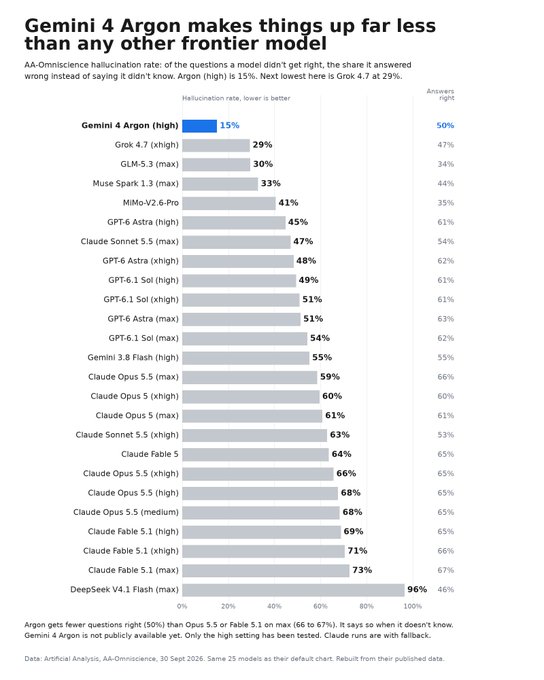
Source: @rdominguezibar. The headline is that post’s wording. The footnote dates the bars to Artificial Analysis AA-Omniscience on 30 Sept 2026 and rounds Argon (high) to 15% hallucination and 50% answers right. It also says Argon was not publicly available and that only the high setting was tested. The table above uses the October 5 model record: 15.1% (0.1506986) and 49.9% accuracy.
What the denominator counts
According to the AA-Omniscience methodology, accuracy is correct answers divided by all questions. Hallucination rate is:
incorrect / (incorrect + partial + not attempted)Correct answers are excluded from that hallucination denominator. The metric asks how often the model asserts an incorrect answer among cases where it did not receive a correct score; it is not an all-answer error rate.
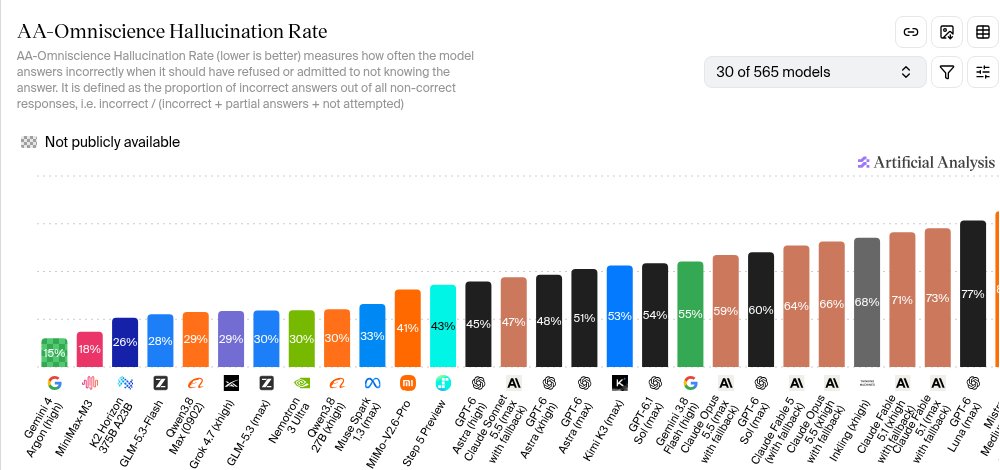
Source: @Cozycanvas53144, a screenshot of the Artificial Analysis chart. Argon (high) is at 15% and marked not publicly available. The definition printed on the chart is the same ratio as the formula above: incorrect divided by incorrect, partial answers, and not attempted.
An illustrative calculation
The following 1,000-question split is a hypothetical example of the formula, not Argon’s observed answer counts:
| Illustrative outcome | Count |
|---|---|
| Correct | 800 |
| Incorrect | 30 |
| Partial or not attempted | 170 |
The conditional hallucination rate is 30 / (30 + 170) = 15%. The outright-wrong share across all questions is 30 / 1,000 = 3%. Argon’s actual AA-Omniscience accuracy in the snapshot is about 49.9%, so the 800/30/170 example must not be presented as Argon’s split.
What the score supports
The score supports a limited statement: on this evaluation, Argon’s incorrect-answer rate among non-correct outcomes is about 15.1%. It does not show that every answer is reliable, that the model abstains whenever it lacks knowledge, or that hallucinations have disappeared. Accuracy below 50% on the same record also means the model did not answer roughly half of that evaluation correctly.
For the rest of Argon’s reported evaluations, see benchmarks by source. For token rates and access timing, see API pricing and the release status. Gemma 4 is a separate open-weight model; its practical troubleshooting guide is here.
Try Gemma 4 online
~/gemma4 $ Try Gemma 4 in the browser playground before setting up a local installation.
Open Gemma 4 playground />

