
“Benchmaxxing” is a disputed label for a possible gap between benchmark performance and everyday coding. The evidence available on October 5, 2026 supports a narrower conclusion: Gemini 4 Argon has strong published results, while those results do not establish how it will perform on every real repository or interface.
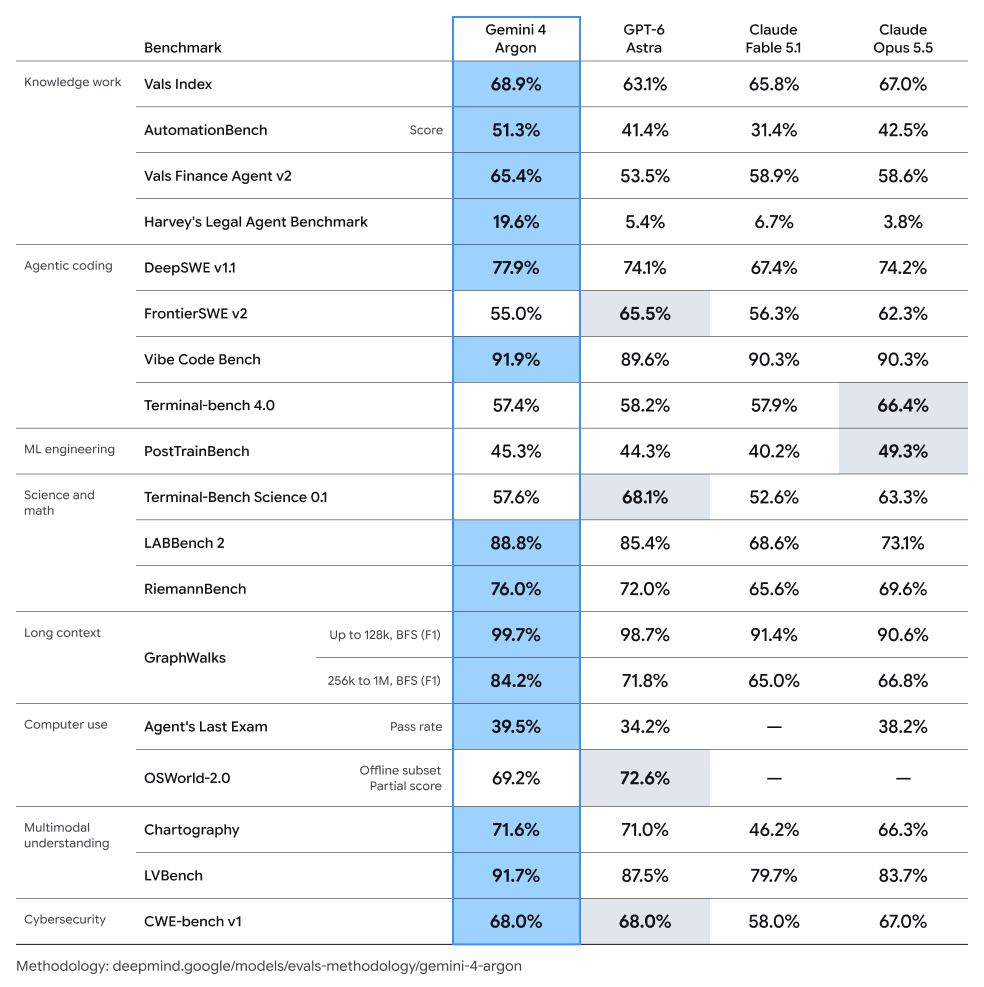
Source: Sundar Pichai, September 30, 2026. Shaded cells are benchmarks where another model leads. FrontierSWE v2 shows Astra at 65.5% and Argon at 55.0%. Terminal-bench 4.0 shows Opus 5.5 at 66.4% and Argon at 57.4%. DeepSWE v1.1 on the same table is 77.9% for Argon. The 57% Artificial Analysis figure in the next table is reported separately. It is not this 57.4% cell.
Three benchmark records, three different questions
These results should stay separate because they measure different tasks and come from different sources.
| Source and evaluation | Argon result | What it measures |
|---|---|---|
| Google announcement, DeepSWE v1.1 | 77.9% | Google's long-horizon software-engineering result |
| Artificial Analysis model record, Terminal-Bench 4.0 | 57% | One component of the AA Intelligence Index evaluation set |
| FrontierSWE V2 leaderboard, proximus harness | 55.0% mean@5 | 34 tasks, five trials per task, 20-hour budget |
The FrontierSWE page also reports 65.5% for GPT-6 Astra and 62.3% for Claude Opus 5.5 under the same headline setup. Its score is mean@5; the whiskers show the worst and best trial results, not confidence intervals. FrontierSWE is a separate evaluation from Google's DeepSWE v1.1 and Artificial Analysis's Terminal-Bench 4.0.
What the scores do and do not establish
The practical takeaway is that none of these measurements is a daily coding leaderboard. They do not answer how often a model preserves an existing UI, avoids regressions, recovers from a failed tool call, or leaves a repository passing its tests. A higher result on one benchmark can coexist with a frustrating workflow on a different task.
The available primary sources also do not establish that Argon was trained on a test set, so that speculation cannot settle the coding question.
A fair real-workflow test for Argon
When Argon is available for your workload, use a fixed evaluation set that reflects the work you actually do:
- Start with repositories and tasks that were not used in prompt examples, and record the baseline test and build results.
- Include interface changes that require visual checks, keyboard and pointer behavior, responsive states, and accessibility checks rather than judging generated code by inspection alone.
- Run the full regression suite after every change and record new failures, fixes, and rollbacks.
- Inject realistic tool failures or missing context and measure whether the model recovers without unsafe edits or repeated dead ends.
- Track input tokens, output tokens, tool calls, wall time, retries, and reviewer corrections beside pass rates.
That checklist turns “does it code well?” into observable outcomes. It also lets a team compare Argon with Astra, Opus, or Sol on the same work instead of treating unrelated benchmark percentages as interchangeable.
What “benchmaxxing” should mean in practice
Use the word as a question about transfer from a benchmark to a workflow, not as a verdict about Argon's training or honesty. The evidence supports reporting the benchmark, its configuration, and its limits. A daily coding winner requires repeatable task results from the workload a reader cares about.
Related reading
Try Gemma 4 online
~/gemma4 $ Try Gemma 4 in the browser playground before setting up a local installation.
Open Gemma 4 playground />


