
Claude Opus 5.5 scores higher than Gemini 4 Argon on the Artificial Analysis Intelligence Index snapshot from October 5, 2026, and it leads three of the four detailed evaluations listed in that comparison. Argon leads AutomationBench-AA and has the lower estimated cost per task. That is a measurable tradeoff; it is not proof that either model owns a particular software specialty.
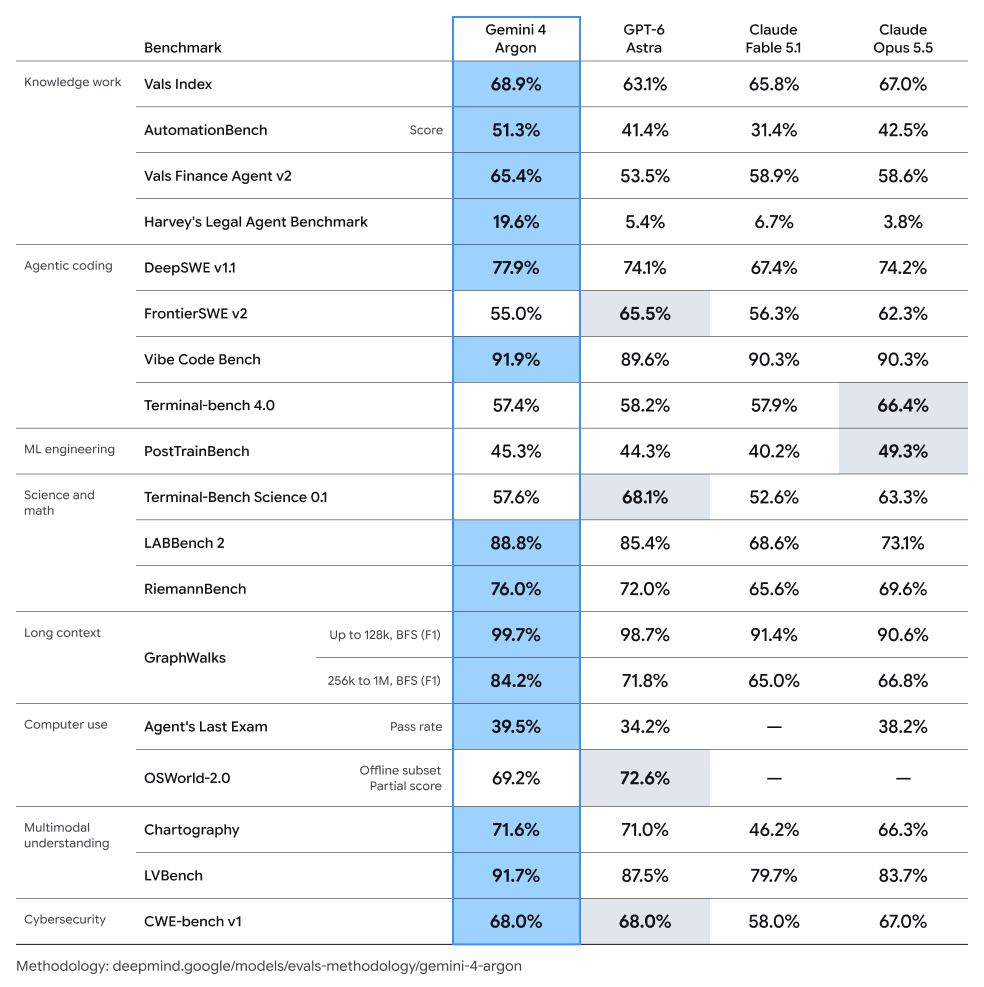
Source: Sundar Pichai, September 30, 2026. On this Google table, Terminal-bench 4.0 is 57.4% for Argon and 66.4% for Opus 5.5, and Opus’s cell is shaded. Astra is 58.2% and Fable 5.1 is 57.9% on that row. Those percentages are not the Artificial Analysis Terminal-Bench 4.0 figures in the table below, which are 57% and 60%.
Argon High vs Opus 5.5 at a glance
The Artificial Analysis comparison evaluates Gemini 4 Argon High against Claude Opus 5.5 Max, Default Fallback. The figures below are the October 5, 2026 snapshot.
| Evaluation | Gemini 4 Argon High | Claude Opus 5.5 Max, Default Fallback |
|---|---|---|
| Artificial Analysis Intelligence Index | 53 | 58 |
| Estimated cost per task | $1.99 | $5.98 |
| AutomationBench-AA | 78% | 70% |
| Terminal-Bench 4.0 | 57% | 60% |
| GDP.pdf | 22% | 26% |
| AA-LCR v1.1 | 80% | 85% |
Opus leads the index by 5 points, Terminal-Bench 4.0 by 3 points, GDP.pdf by 4 points, and AA-LCR v1.1 by 5 points. Argon leads AutomationBench-AA by 8 points. The per-task estimate is $1.99 for Argon and $5.98 for Opus in this snapshot.
How to read the task-fit difference
The table suggests a starting point for testing:
- Put Argon on an automation-heavy workflow if the 78% AutomationBench-AA result maps to the actions your system needs.
- Put Opus on a workflow where terminal execution, document reasoning, or the AA-LCR task family matters and its higher scores are worth the added cost.
- Measure completed work on your own prompts. A benchmark score does not establish a universal winner for daily coding, interface work, or long-form writing.
The evaluated configurations do not justify assigning frontend or backend identities to these models. Tool access, context, tests, and retry behavior can change the practical result.
Token rates are separate from cost per task
The same Artificial Analysis comparison lists these rates for the evaluated configurations:
| Price item | Gemini 4 Argon High | Claude Opus 5.5 Max, Default Fallback |
|---|---|---|
| Input / output per 1M tokens | $2 / $10 | $4 / $20 |
| Cached input per 1M tokens | $0.10 | $0.20 |
The per-task figures are weighted evaluation costs, not flat fees that every customer pays for every request. A production run can have a different token mix, tool path, and completion length. Use the rate card for budgeting and a representative task set for unit economics.
Availability is part of the comparison
Google's September 30 announcement says Argon initially goes to trusted cyber defenders through Fairwind and is used internally, with wider release beginning for paid API customers and Google AI Ultra subscribers. The announcement does not promise a release date for every account. Check the Argon access details before comparing a model you can call with one that may still be restricted.
Related reading
Try Gemma 4 online
~/gemma4 $ Try Gemma 4 in the browser playground before setting up a local installation.
Open Gemma 4 playground />


